From Patchwork Funding to Strategic Coherence: Sustainability Strategies for University Research Centers
University research centers and institutes are being asked to do more with less. Many are navigating shrinking funding pools, heightened competition, and increasing expectations to demonstrate real-world impact. At the same time, the work itself is becoming more complex: center leaders are balancing research, service, partnerships, communications, and business development while trying to keep teams stable and missions clear.
On March 10, Saath Partners were invited by the Consortium of University Public Service Organizations (CUPSO) and we facilitated a webinar, “Rethinking Center Sustainability,” designed for center directors and staff navigating this reality every day. The session created space to name what is hard right now, and to introduce a practical way to move from reactive project-chasing toward a more durable, strategic approach to sustainability.
Below are the key themes, the framework we shared, and the takeaways participants can put into action.
Why this conversation matters now
Many centers are operating inside a patchwork funding model: a mix of state or local contracts, sponsored projects, fee-for-service work, occasional grants, and limited university support. The result is not just financial uncertainty. It shapes how a center works day-to-day:
Work becomes fragmented across many projects with different stakeholders and messages.
Staff time gets split between delivery and constant business development.
Teams struggle to tell a cohesive “why we exist” story that resonates internally and externally.
Leaders feel perpetually busy while still feeling unstable, like they are “spinning wheels.”
In the current funding environment, those dynamics are intensifying. Participants described an “opportunity starved, competition rich environment,” where fewer opportunities are available and even large competitors are moving downstream into smaller projects. Funders are also shifting expectations: proposals must demonstrate impact value, partnership strategy, and connection from research to outcomes as differentiating factors.
This is exactly why sustainability cannot be solved only as a funding question.
A familiar pattern for many centers
As participants shared challenges, a consistent pattern came through: sustainability often becomes an urgent funding question, even when the underlying issue is lack of strategic coherence across projects, partners, and messaging.
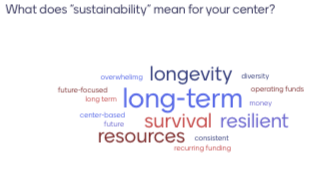
To ground the discussion, we asked:
“What does sustainability mean for your center?”
The word cloud surfaced a clear set of priorities:
Long-term plan: long-term, longevity, being future-focused
Resilience under pressure: resilient, survival (and what can feel overwhelming in the current environment)
Resources that keep the work going: resources, operating funds, money, recurring funding, consistent support
That mix reflects what many center leaders are carrying right now: the pressure to keep programs and people afloat, the urgency to find stable resources, and the very real sense that the ground is shifting under long-standing funding models. When “long-term” and “survival” show up side-by-side, it is not abstract. It is a signal of how high the stakes feel, and how hard it can be to make space for strategic thinking when the immediate needs are so present.
With that reality on the table, we used the rest of the webinar to help participants practice a different starting point, one that begins with clarity about their role in the ecosystem and the value they create for stakeholders, so sustainability planning is not only reactive to the next opportunity.
The “opportunity cost” of starting with funding
A core idea we explored is that when centers begin with “What funding can we get?” they often end up with:
Fragmented narratives across different projects
Project-based, transactional partnerships rather than strategic ones
Loss of differentiation (it becomes harder to articulate the unique gap the center fills)
Focus on outputs rather than outcomes
Difficulty measuring and communicating system-level impact
This is not a failure of effort or competence. It is a predictable outcome of a system that incentivizes short-term deliverables.
Seeing the ecosystem (and how value flows)
A sustainability strategy strengthens when a center understands its stakeholder ecosystem: not just who funds the work, but who can use it, share it, build on it, and advocate for it.
Participants reflected on how often valuable insights stay too close to a single contract or deliverable, even when the learning could support broader practice, policy, and investment decisions. We used that as a bridge into a more strategic starting point: clarifying the role the center wants to play in the ecosystem and strengthening partnerships that amplify outcomes.
The framework: Strategic Coherence
We introduced a Strategic Coherence framing that helps leaders connect the dots between what they do, who it matters to, and how value travels through an ecosystem.
Strategic Coherence = Understanding what you are doing (research) + How knowledge will be utilized by stakeholders (impact and usability) + Stronger partnerships
Strategic Coherence → creates impact
Strategic Coherence → builds narrative for funders
Strategic Coherence → attracts aligned funding
This shifts sustainability planning from “chasing” to “positioning.”
Instead of only asking, “What’s the next grant?” we encouraged leaders to start with questions like:
What role does our center want to play in the broader ecosystem?
How does our work create value for individual stakeholders and across stakeholders?
How can we move relationships toward true partnership that amplifies outcomes?
How can we work with partners to develop opportunities together (not only react after an opportunity appears)?
How does this connect back to our university’s research, service, and impact missions?
Collective reflections
One of the richest parts of the webinar was hearing participants name the realities they are navigating right now. While every center’s context is different, several common themes stood out:
1. The pressure to meet growing demand for service-based work without sustainable resourcing
Participants reflected on how much of a center’s value is delivered through service-based work, such as evaluation, training, facilitation, and technical assistance. At the same time, the way this work is funded, scoped, or priced can make it hard to build the capacity and continuity needed for the long term.
2. The challenge of working within internal systems that are not designed for center realities
Several participants pointed to a structural mismatch: many institutional processes and budgeting norms are not built for the pace, variability, and timelines of externally funded, partner-driven work. This can create friction even when the center’s work is strongly valued.
3. The experience of a more competitive and less predictable opportunity landscape
Participants described a landscape where opportunities can feel fewer and harder to secure, while competition continues to rise. For many centers, this changes what it takes to maintain stability and plan ahead.
4. The difficulty of helping valuable insights travel beyond a single project
Participants shared that meaningful deliverables and findings are often completed and appreciated, but do not always get leveraged beyond the immediate sponsor or contract. Constraints around communications capacity, ownership, and risk can limit broader learning and uptake.
5. The tension between immediate delivery pressures and long-term sustainability work
A central reflection was about time and capacity. Building a coherent, ecosystem-oriented strategy takes sustained attention, but near-term delivery needs and funding pressures can make it difficult to protect that time.
These reflections reinforced why the webinar focused on helping participants practice a different starting point: clarifying the role a center wants to play in its ecosystem, strengthening partnership strategy, and building a clearer narrative of value that can hold across projects.
Key takeaways (what to do next)
During the webinar, participants shared that the “what” and “why” of an ecosystem approach resonated, and that what would be most helpful next is the “how”: concrete steps for where to start, especially while managing real project-to-project pressures.
If this sounds familiar, it may be time to step back and ask a different set of strategy questions: not only “What can we win next?” but also “What role are we uniquely positioned to play, and what partnerships and narratives will make that role sustainable?”
If you are leading or supporting a research center and feeling the sustainability squeeze, here are five practical takeaways from the session:
Start with role clarity before funding strategy. Define the role you want to play in the ecosystem, then pursue funding that reinforces that role.
Build coherence across projects. Look for the through-line: what is the larger story your body of work is telling?
Invest in partnerships that amplify outcomes. Strong partnerships are not just a delivery mechanism. They are a sustainability asset.
Design utilization of your research as part of the work, not after it. Make translation and usability visible in your approach, especially as funders reward pathways to impact.
Give yourself a longer planning horizon. Ecosystem-based strategy is a multi-year commitment, and it changes what becomes possible.
Saath Partners works with research centers, institutes, and cross-sector initiatives to bring clarity to positioning, strengthen partnership strategy, and translate research into usable value that stakeholders can act on.